Un compás
A Voyage from Spain to the Orient
U Trojského zámku 1, Prague 7
Artists
Programme
Dimitrie Cantemir (1673–1723)
Bestenigar
Mateo Pérez de Albéniz (1755-1831)
Sonata en Re M
Aga Riza (?)
Makam Huseyni
Manuscript Cantemir
Gaspar Sanz (1640–1710)
Marionas, Canarios
Alonso Mudarra (1510–1580)
Pavana-Gallarda
Fantasia X
Il Barbarino (17th century)
Quaranta e Saltarello
Luis de Narváez (1500–1549)
Romanesca
G. Kapsberger (1580–1651)
Colassione
Anonymous songs
from Sephardic, Basque, Iranian and Greek traditions
Concert with intermission.
Expected end of the concert: 22:00.
Annotation
The Troja Chateau is a perfect location for this performance at a festival dedicated to the Mediterranean. The baroque villa itself stands by the water, according to its mythological model, conquered by Odyssey.
During the Summer Festivities of Early Music, the Prague Troy gets regularly seized by Spanish music. This July, it will be invaded by Euskal Barrokensemble with Enrike Solinís and his dulcet guitar at the head. But since the real destination on their musical campaign are the gates of Orient, the musicians invited a most competent cicerone to join them on the way: the impressive Persian player on setar, Kiya Tabassian.
The programme, comprising music by Gaspar Sanz or Alonso Mudarra, will illustrate that “compás” in Spanish does not only designate the navigation instrument, but also the essential tools for orientation in musical space, i.e. rhythm and tempo.
Venue
U Trojského zámku 1, Prague 7
Show on mapPartners of the concert
In collaboration with the Embassy of Spain in Prague, the Institute Cervantes, Prague Acción Cultural Española (AC/E), Etxepare Basque Institute, Ministerio de Educación, Cultura y Deporte and Prague City Gallery.
Artists
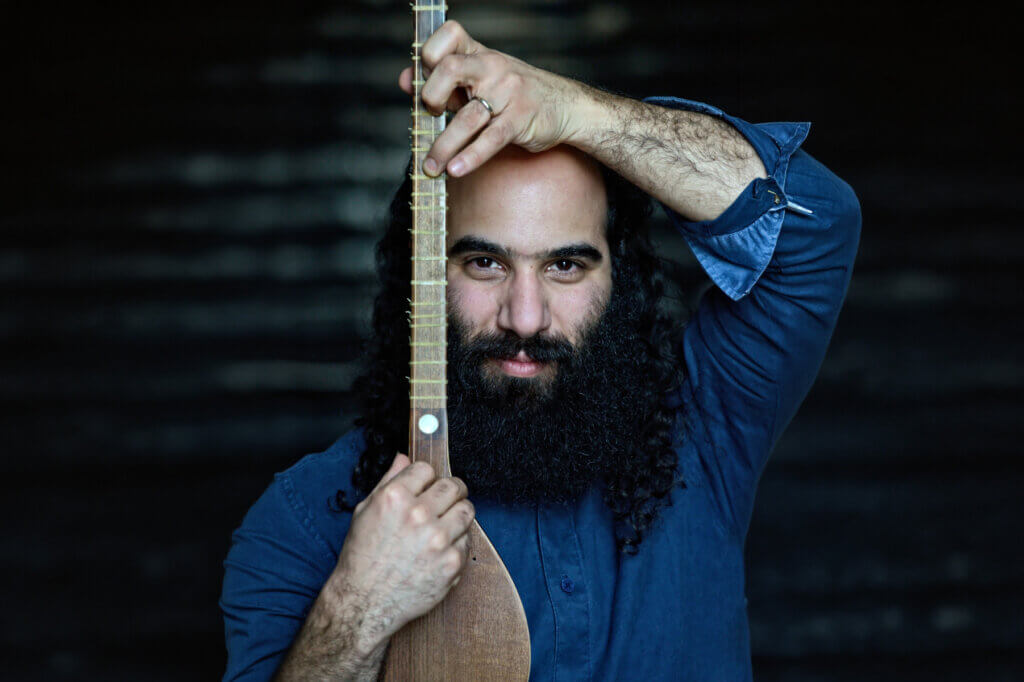
Kiya Tabassian
setar, voice
Kiya Tabassian is a worldly renowned setar virtuoso and composer who has established a prominent international career as a soloist and as the founder and artistic director of the ensemble Constantinople. Known for his cross-cultural musical creations, he performs worldwide and engages in projects that bridge traditions, contemporary music, and improvisation.
He has collaborated with major institutions such as the Orchestre symphonique de Montréal, Canadian Broadcasting Corporation, and the Nouvel Ensemble Moderne, and has taken part in the international MediMuses project dedicated to Mediterranean music research. Since 2009, he has been involved with the Netherlands based chamber Atlas Ensemble and its Atlas Academy educative branch, contributing as a performer and tutor to initiatives linking oral traditions and contemporary music.
In 2015, he founded and directed the first world music residency programme at the Banff Centre for Arts and Creativity. From 2017 to 2022, he served as Associate Artist at the Rencontres musicales de Conques in France, presenting both festival programmes and new creations with Constantinople.
His work has been recognised with major international awards, including the 2024 Juno Award for Best Classical Album (Small Ensemble) and the 2025 Anděl Award for his collaboration with Cappella Mariana.
He is also the artistic director of the Centre des musiciens du monde, a music centre he co-founded in Montreal in 2017, as a space for creation, meetings, exchanges and the transmission of knowledge between professional musicians and the public. For many years, his work has been supported by the Conseil des arts de Montréal, the Conseil des arts et des lettres du Québec and the Canada Council for the Arts.

Enrike Solinís
lavta, guiterne, Baroque guitar and artistic director
Born in Bilbao, Enrike Solinís Azpiazu studied guitar and early music at the Conservatorio Superior de Música J. C. de Arriaga in Bilbao, and at the Escola Superior de Música de Catalunya in Barcelona. Winner of numerous international awards, including the Concurso Internacional de Comillas, the Concurso Internacional Ataulfo Argenta, and the Concurso Internacional Andrés Segovia, he is considered one of the great virtuosi of his generation.
Solinís has performed with such prestigious ensembles as Hespèrion XXI, Le Concert des Nations, and la Capella Real de Catalunya (all directed by Jordi Savall), the Akademie für Alte Musik, and Le Concert d’Astrée. He has appeared at major international stages, including Carnegie Hall, the Konzerthaus Berlin, and the Théâtre des Champs-Elysées in Paris. He has recorded on Glossa, Naïve, Zig-Zag Territories, Arsis, Alta Vox, and other labels. He also directs his own Baroque ensemble, the Euskal Barrokensemble, founded in Bilbao in 2006.

Euskal Barrok Ensemble
The ensemble was founded in 2006 by its artistic director and guitar virtuoso Enrike Solinís. It focuses on the musical tradition of both European and American cultures. The unique approach of the ensemble’s founder consists in presenting nearly forgotten works, highlighting the richness of musical heritage. In addition to the high level of the interpretative skills of all its members, the ensemble offers a varied range of musical styles (from early music to popular music) that includes music from various countries and corners of the world.
Euskal Barrok Ensemble is a regular guest at international music festivals such as the Montreal Baroque Festival, Auditorio Nacional in Madrid, Euskalduna Jauregia in the Basque Country, the Leo Brouwer Festival in Havana, the Stockholm Early Music Festival, and others.
The ensemble has released several CDs (on the Glossa and Alia Vox labels) featuring Baroque dance music from southern Europe and Turkey, early music from the Basque Country and Brazilian polyphonic music from the Anchieta region. The CD “Elkano” (Alia Vox, 2019) was nominated for the International Music Awards in 2020.